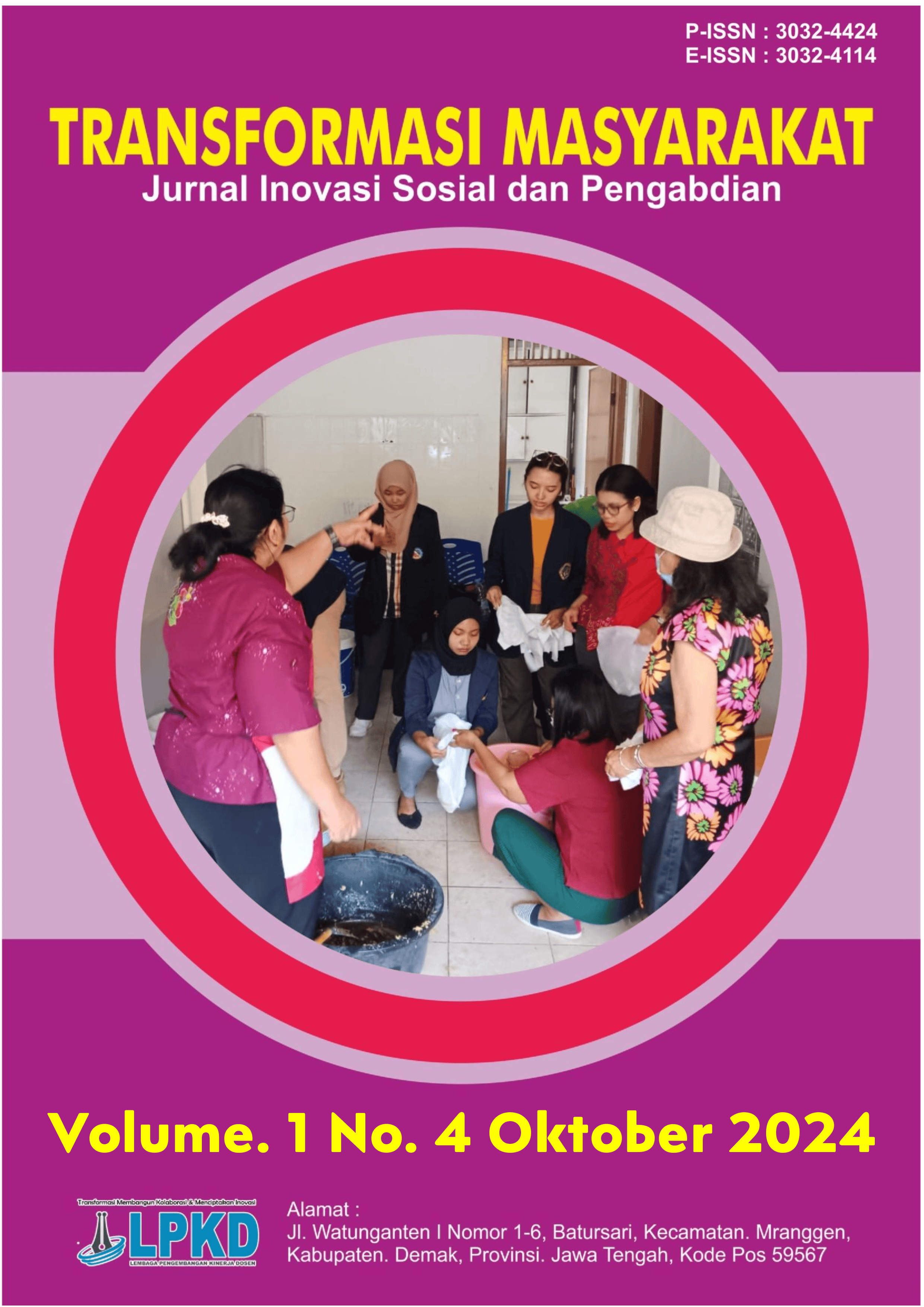
Sosialisasi Anti-Bullying dan Kekerasan Seksual: Upaya Mewujudkan Lingkungan Belajar yang Aman dan Nyaman di SDN 01 Tosari
DOI:
https://doi.org/10.62383/transformasi.v1i4.660Keywords:
Anti-Bullying, Sexual Violence, Elementary School, Socialization, Learning EnvironmentAbstract
The socialization of anti-bullying and sexual violence in elementary schools is a crucial step in creating a safe and comfortable learning environment for students. This article discusses effective socialization strategies, the roles of teachers and parents, and the impact of these activities on student behavior. A case study was conducted in several elementary schools in [City Name], showing a decrease in bullying and sexual violence incidents following the socialization efforts. Recommendations for broader implementation are also provided.
References
Bear, G. G., Yang, C., & Pasipanodya, E. (2015). Assessing school climate: Validation of a brief measure of the perceptions of parents. Journal of Psychoeducational Assessment, 33(2), 115-129. https://doi.org/10.1177/0734282914545748
Bradshaw, C. P., Sawyer, A. L., & O’Brennan, L. M. (2007). Bullying and peer victimization at school: Perceptual differences between students and school staff. School Psychology Review, 36(3), 361–382. https://doi.org/10.1080/02796015.2007.12087929
Bradshaw, C. P., Sawyer, A. L., & O’Brennan, L. M. (2009). A social disorganization perspective on bullying-related attitudes and behaviors: The influence of school context. American Journal of Community Psychology, 43, 204-220. https://doi.org/10.1007/s10464-009-9240-1
Bradshaw, C. P., Waasdorp, T. E., O’Brennan, L. M., & Gulemetova, M. (2013). Teachers' and education support professionals' perspectives on bullying and prevention: Findings from a National Education Association study. School Psychology Review, 42(3), 280–297. https://doi.org/10.17105/spr-2015-0036.v42-3
Cohen, J., McCabe, E. M., Michelli, N. M., & Pickeral, T. (2009). School climate: Research, policy, practice, and teacher education. Teachers College Record, 111(1), 180-213. https://doi.org/10.1177/016146810911100108
Cross, D., Monks, H., Hall, M., Shaw, T., Pintabona, Y., Erceg, E., & Lester, L. (2011). Three-year results of the Friendly Schools whole-of-school intervention on children's bullying behaviour. British Educational Research Journal, 37(1), 105-129. https://doi.org/10.1080/01411920903420024
Cross, D., Shaw, T., Hearn, L., Epstein, M., Monks, H., Lester, L., & Thomas, L. (2011). Australian covert bullying prevalence study (ACBPS). Child Health Promotion Research Centre, Edith Cowan University, Perth.
Espelage, D. L., & Swearer, S. M. (2003). Research on school bullying and victimization: What have we learned and where do we go from here? School Psychology Review, 32(3), 365-383. https://doi.org/10.1080/02796015.2003.12086200
Espelage, D. L., Low, S., & Polanin, J. R. (2015). Teacher and staff perceptions of school environment as predictors of student aggression, victimization, and willingness to intervene in bullying situations. School Psychology Quarterly, 30(3), 360-377. https://doi.org/10.1037/spq0000072
Espelage, D. L., Low, S., Polanin, J. R., & Brown, E. C. (2015). The impact of a middle school program to reduce aggression, victimization, and sexual violence. Journal of Adolescent Health, 56(2), S3-S11. https://doi.org/10.1016/j.jadohealth.2013.02.021
Farmer, T. W., McAuliffe Lines, M., & Hamm, J. V. (2011). Revealing the invisible hand: The role of teachers in children's peer experiences. Journal of Applied Developmental Psychology, 32(5), 247-256. https://doi.org/10.1016/j.appdev.2011.04.006
Finkelhor, D. (1994). Current information on the scope and nature of child sexual abuse. The Future of Children, 4(2), 31-53. https://doi.org/10.2307/1602522
Holt, M. K., & Espelage, D. L. (2009). Perceived social support among bullies, victims, and bully-victims. Journal of Youth and Adolescence, 36(8), 984-994. https://doi.org/10.1007/s10964-006-9153-3
Jennings, P. A., & Greenberg, M. T. (2009). The prosocial classroom: Teacher social and emotional competence in relation to student and classroom outcomes. Review of Educational Research, 79(1), 491-525. https://doi.org/10.3102/0034654308325693
Libbey, H. P. (2004). Measuring student relationships to school: Attachment, bonding, connectedness, and engagement. Journal of School Health, 74(7), 274-283. https://doi.org/10.1111/j.1746-1561.2004.tb08284.x
Mitra, D. L. (2006). Increasing student voice and moving toward youth leadership. The Prevention Researcher, 13(1), 7-10.
O’Brennan, L. M., Waasdorp, T. E., & Bradshaw, C. P. (2014). Strengthening bullying prevention through school climate and school culture. Journal of School Violence, 13(1), 93-104. https://doi.org/10.1037/a0035957
Olweus, D. (1993). Bullying at school: What we know and what we can do. Blackwell Publishing. https://doi.org/10.1002/pits.10114
Paluck, E. L., & Shepherd, H. (2012). The salience of social referents: A field experiment on collective norms and harassment behavior in a school social network. Journal of Personality and Social Psychology, 103(6), 899-915. https://doi.org/10.1037/a0030015
Piaget, J. (1932). The moral judgment of the child. Free Press, New York.
Salmivalli, C. (2010). Bullying and the peer group: A review. Aggression and Violent Behavior, 15(2), 112-120. https://doi.org/10.1016/j.avb.2009.08.007
Salmivalli, C. (2014). Participant roles in bullying: How can peer bystanders be utilized in interventions? Theory into Practice, 53(4), 286-292. https://doi.org/10.1080/00405841.2014.947222
Smith, P. K., & Brain, P. (2000). Bullying in schools: Lessons from two decades of research. Aggressive Behavior, 26(1), 1-9. https://doi.org/10.1002/(sici)1098-2337(2000)26:1<1::aid-ab1>3.0.co;2-7
Stewart, E. A. (2008). School social bonds, school climate, and school misbehavior: A multilevel analysis. Justice Quarterly, 25(1), 1-29. https://doi.org/10.1080/07418820300095621
Swearer, S. M., Espelage, D. L., Vaillancourt, T., & Hymel, S. (2010). What can be done about school bullying? Linking research to educational practice. Educational Researcher, 39(1), 38-47. https://doi.org/10.3102/0013189x09357622
Thapa, A., Cohen, J., Guffey, S., & Higgins-D'Alessandro, A. (2013). A review of school climate research. Review of Educational Research, 83(3), 357-385. https://doi.org/10.3102/0034654313483907
Ttofi, M. M., & Farrington, D. P. (2011). Effectiveness of school-based programs to reduce bullying: A systematic and meta-analytic review. Journal of Experimental Criminology, 7(1), 27-56. https://doi.org/10.1007/s11292-010-9109-1
Waasdorp, T. E., Bradshaw, C. P., & Leaf, P. J. (2011). The impact of schoolwide positive behavioral interventions and supports on bullying and peer rejection: A randomized controlled effectiveness trial. Archives of Pediatrics & Adolescent Medicine, 166(2), 149-156. https://doi.org/10.1001/archpediatrics.2011.755
Wang, C., Berry, B., & Swearer, S. M. (2013). The critical role of school climate in effective bullying prevention. Theory into Practice, 52(4), 296-302. https://doi.org/10.1080/00405841.201
Downloads
Published
How to Cite
Issue
Section
License
Copyright (c) 2024 Transformasi Masyarakat : Jurnal Inovasi Sosial dan Pengabdian

This work is licensed under a Creative Commons Attribution-ShareAlike 4.0 International License.