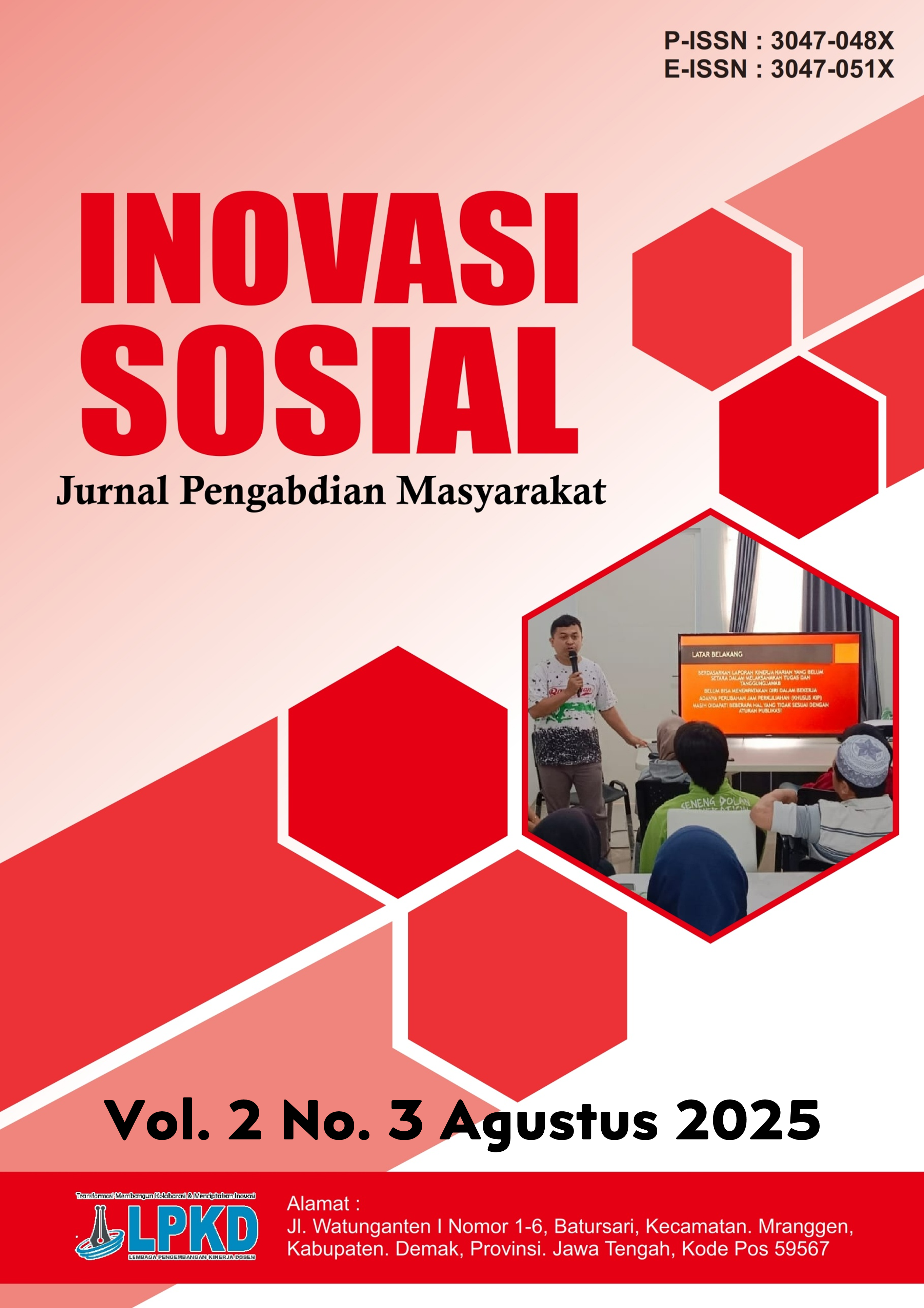
Pelatihan Mindfulness pada Guru PAUD ANANDA di RW 19 Sendangmulyo-Semarang
DOI:
https://doi.org/10.62951/inovasisosial.v2i3.2000Keywords:
Ananda Preschool Teachers, Mental Health, Mindfulness, Teacher Well-being, TrainingAbstract
The purpose of this community service (PkM) is to provide Mindfulness training to ANANDA PAUD teachers in RW.19 to improve their understanding of themselves regarding their physical and psychological well-being. Mindfulness training is a meditation method used to increase empathy both affectively, cognitively, morally, intrapersonally and interpersonally. The many activities and activities of teachers both at school and at home make teachers feel very tired. Teachers often feel dizzy, physically tired and lack focus on the teaching given. To prevent these things from continuing, the PkM team of the psychology faculty provides assistance to teachers by holding Mindfulness training which aims to maintain the mental state of teachers from the pressures that arise both at work and brought from home. The lack of understanding and self-skills possessed by the teachers makes them just resigned in carrying out their daily activities. This input prompted the PkM team to help find solutions for developing the self-skills of ANANDA PAUD teachers through Mindfulness Training. The process involved gathering the teachers in the RT.01 hall and providing them with materials to understand and practice Mindfulness, including lectures, stories, and practical exercises, as well as games and group discussions. The community service team hopes that these teachers will be able to understand the results of the training. This increased understanding of Mindfulness will improve their ability to focus and better understand themselves and their surroundings, enabling them to overcome all the challenges and obstacles that arise in their daily lives.
References
Allen, N. B., & Knight, W. E. J. (2005). Mindfulness, compassion for self and compassion for others. In P. Gilbert (Ed.), Compassion, conceptualisations, research and use in psychotherapy (pp. xx–xx). London & New York: Routledge Taylor & Francis Group.
Bauer, J., Stamm, A., Virnich, K., Wissing, K., Müller, U., & Wirsching, M. (2006). Correlation between burnout syndrome and psychological and psychosomatic symptoms among teachers. International Archives of Occupational and Environmental Health, 79(3), 199–204. https://doi.org/10.1007/s00420-005-0050-y
Beddoe, A. E., & Murphy, S. O. (2004). Does mindfulness decrease stress and foster empathy among nursing students? Journal of Nursing Education, 43(7), 305–312. https://doi.org/10.3928/01484834-20040701-07
Brown, K. W., Ryan, R. M., & Creswell, J. D. (2007). Mindfulness: Theoretical foundations and evidence for its salutary effects. Psychological Inquiry, 18(4), 211–237. https://doi.org/10.1080/10478400701598298
Cho, S., Lee, H., Oh, K. J., & Soto, J. A. (2017). Mindful attention predicts greater recovery from negative emotions, but not reduced reactivity. Cognition and Emotion, 31(5), 1–10. https://doi.org/10.1080/02699931.2016.1199422
Davis, L. W., Strasburger, A. M., & Brown, L. F. (2007). Mindfulness: An intervention for anxiety in schizophrenia. Journal of Psychosocial Nursing, 45(11), 23–29. https://doi.org/10.3928/02793695-20071101-06
Germer, C. K., Siegel, R. D., & Fulton, P. R. (2005). Mindfulness and psychotherapy. New York: The Guilford Press.
Kabat-Zinn, J. (1990). Full catastrophe living: Using the wisdom of your body and mind to face stress, pain, and illness. New York: Bantam Dell.
Khairiah, K., Susanti, E., & Wulandari, D. (2022). Problematika kompetensi di kalangan guru pendidikan anak usia dini (PAUD) di Indonesia. Khazanah: Jurnal Studi Islam dan Humaniora, 2(2), 87–99. https://doi.org/10.29300/kh.v2i2.6281
Kusmiran, Y., Agustin, M., & Dahlan, T. H. (2024). Peran mindfulness teaching dalam mengurangi stres dan meningkatkan kualitas pengajaran guru PAUD. Aulad: Journal on Early Childhood, 7(3), 709–722. https://doi.org/10.31004/aulad.v7i3.777
Maharani, E. A. (2017). Pengaruh pelatihan berbasis mindfulness terhadap tingkat stres pada guru PAUD. Jurnal Penelitian Ilmu Pendidikan, 9(2), 100–110. https://doi.org/10.21831/jpipfip.v9i2.12919
Mathias, D., Filip, R., Mia, L., Sara, L., & David, D. (2008). Mindfulness skills and interpersonal behaviour. Personality and Individual Differences, 44(5), 1235–1245. https://doi.org/10.1016/j.paid.2007.11.018
Rachmat. (2013, Maret 2). Organisasi kepemudaan. Kompasiana. http://edukasi.kompasiana.com/2013/03/02/organisasi-kepemudaan-menonjolkan-kemampuan-sosial-tapimematikan-kecerdasan-tematis-533604.html
Roeser, R. W., Skinner, E., Beers, J., & Jennings, P. A. (2012). Mindfulness training and teacher’s professional development: An emerging area of research and practice. Child Development Perspectives, 6(2), 167–173. https://doi.org/10.1111/j.1750-8606.2012.00238.x
Simarmata, S. W., Sagita, D. D., Batubara, A., Simangunsong, J., & Violina, E. I. (2024). E-modul berbasis mindfulness untuk meningkatkan psychological well-being guru PAUD. Jurnal Ilmiah Bimbingan Konseling Undiksha, 15(3), 258–267. https://doi.org/10.23887/jibk.v15i3.87303
Downloads
Published
How to Cite
Issue
Section
License
Copyright (c) 2025 Inovasi Sosial : Jurnal Pengabdian Masyarakat

This work is licensed under a Creative Commons Attribution-ShareAlike 4.0 International License.